The Pharaoh's Passport
Date: July 17, 2024
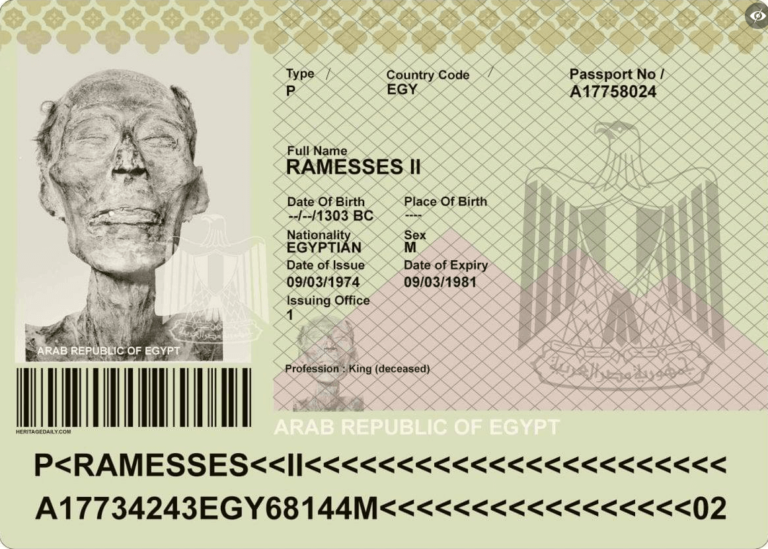
not a real image of the passport
Who is Ramesses II?
Ramesses II, also known as Ramesses the Great, is one of ancient Egypt’s most celebrated and powerful pharaohs. His reign, lasting from 1279 to 1213 BC., was marked by monumental achievements in architecture, military conquests, and governance, leaving an indelible legacy that endures to this day.
Born to Pharaoh Seti I and Queen Tuya, Ramesses ascended the throne at a young age and quickly demonstrated his aptitude for leadership and statecraft. One of his most significant contributions to Egypt’s architectural heritage is the construction of the Ramesseum, a massive mortuary temple dedicated to himself, located in Thebes. This temple, with its grand statues, extensive reliefs, and colossal size, exemplifies Ramesses’ desire to immortalize his reign and deify himself in the eyes of his people.
A Powerful King
Ramesses II’s reign was also distinguished by his military prowess. He is perhaps best known for the Battle of Kadesh, fought against the Hittites in 1274 BC. This battle, one of the largest chariot engagements in history, initially appeared to be a setback for Ramesses due to a strategic ambush by the Hittites. However, through sheer personal bravery and tactical acumen, Ramesses turned the tide, rallying his troops and achieving a stalemate that he later portrayed as a great victory. This encounter solidified his reputation as a formidable warrior king and was immortalized in detailed bas-reliefs at his temples in Abu Simbel and Karnak.
The construction of the temples at Abu Simbel is another testament to Ramesses II’s architectural genius and his desire to project power and divine favor. These twin temples, carved into the mountainside, feature colossal statues of the pharaoh and his queen Nefertari, demonstrating the grandeur and artistic sophistication of his reign. The temples were not only religious centers but also political statements, asserting Egypt’s dominance over Nubia and serving as a reminder of Ramesses’ divine rule.
Ramesses II’s domestic policies were equally impactful. He initiated numerous building projects across Egypt, from the Delta to Nubia, including the completion of his father’s projects and the construction of new temples, palaces, and cities. His administrative reforms and efforts to consolidate central authority strengthened the stability of the Egyptian state. Ramesses’ reign also saw a flourishing of arts and culture, with advancements in literature, sculpture, and architecture reflecting a period of prosperity and relative peace, following the conclusion of his military campaigns.
In addition to his political and military achievements, Ramesses II’s personal life was marked by his large family. He fathered over a hundred children with his many wives, including the notable Queen Nefertari, whose tomb in the Valley of the Queens remains one of the most beautifully decorated burial sites from ancient Egypt. His progeny ensured the continuity of his dynasty and his enduring influence on subsequent generations.
Ramesses II’s death at the age of around 90 was followed by his burial in the Valley of the Kings, and his mummy, now housed in the National Museum of Egyptian Civilization, continues to be a source of fascination for historians and archaeologists. His reign, one of the longest in Egyptian history, left a legacy of monumental achievements that not only defined his era but also shaped the cultural and historical trajectory of ancient Egypt. Ramesses the Great remains a symbol of the might and majesty of the pharaonic tradition, his life and accomplishments serving as a testament to the enduring power and splendor of ancient Egypt.
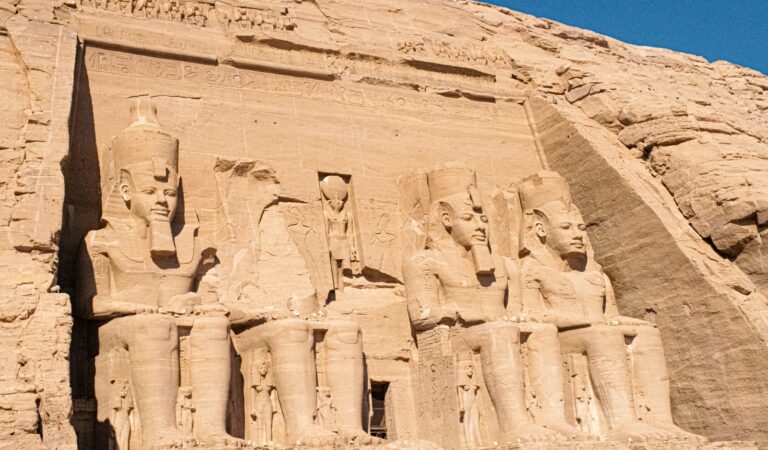
Abu Simbel temple of Ramesses II
Save the Mummy
After about 3,090 years, the tomb of Ramesses II was discovered in 1881 in a wooden coffin in the Valley of the Kings in Luxor by the French Egyptologist Gaston Maspero. After 94 years, in 1975, Dr. Maurice Bucaille, a French physician, author, and researcher in Egyptology, was visiting the mummy of Ramesses II in Cairo when he realized that the mummy’s condition was not good. the mummy was suffering from a fungal infection.
The Passport of the King
Dr. Maurice Bucaille contacted the French authorities about the mummy’s condition and how it needed to be saved. The new French president Valéry d’Estaing talked to the Egyptian authorities about sending the mummy to France for maintenance, and he succeeded in convincing them. However, French law required anybody, dead or alive, to have a passport or identification documents to enter France, which made the Egyptian authorities get a passport for the ancient king.
The King's Arrival
In September 1976, the mummy of Ramesses II arrived France at at Paris–Le Bourget Airport with a full military parade for a king like Ramesses II. The mummy was then sent to the lab of the Musée de l’Homme Museum for further studies and maintenance.